

Posted by writeradmin
I was eating at a restaurant and had a filling crack. Now I’m afraid to eat anything on that side and it has become sensitive. When I went to get this fixed, my dentist says I need a crown now. He’s suggesting a CEREC crown. How can this happen? Part of me is wondering if he just wants to practice with his new CEREC machine he’s been talking about for a while.
Dottie
Dear Dottie,
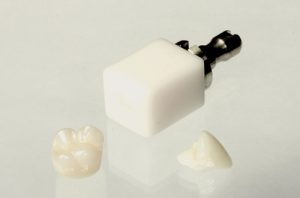
While fillings restore decayed portions of a tooth, they don’t restore its original strength. White composite fillings do a bit better because they bond directly onto the tooth, but it still isn’t a whole natural tooth. Bear in mind that I haven’t examined your teeth so I can’t give you specifics about your tooth. I can give you some generalities.
Teeth Change Over Time
Every day your teeth endure hundreds of pounds of pressure from our biting forces. Over the years, those forces create tiny amounts of stress in the remaining natural tooth. Other factors can add to those stresses.
If you grind your teeth, chew ice, clench during stressful situations, or simply have a very large filling, that stress can eventually lead to cracks developing around the restoration.
The filling itself may still be perfectly intact. It’s the surrounding tooth structure that’s beginning to fail.
Larger Fillings Mean Less Natural Tooth
The larger a filling, the less healthy enamel remains to support your tooth.
This is especially true when an old silver amalgam filling has been in place for decades. While these restorations have served many patients well, they don’t bond to the tooth the same way a white filling does. As the natural tooth flexes under years of chewing pressure, small cracks can eventually develop around the edges.
How Do You Know If a Tooth Is Cracking?
Some cracked teeth produce obvious symptoms, while others can be surprisingly subtle.
Common warning signs include:
- Pain when biting down
- Sensitivity when releasing your bite
- Discomfort with cold foods or drinks
- A rough edge you can feel with your tongue
- A filling that suddenly feels “different”
- A tooth that occasionally hurts without an obvious cavity
Because many cracks don’t appear clearly on X-rays, a thorough clinical examination is often needed to identify the problem.
When Is a Filling No Longer Enough?
If enough healthy tooth remains, replacing your old filling may be all that’s necessary. Though your dentist should check to make sure there is not new decay or an infection.
However, once cracks begin spreading through the cusps—the pointed chewing surfaces of your tooth—a filling may no longer provide enough support. Each time you bite, those weakened sections can flex independently, allowing the crack to grow.
In these situations, your dentist may recommend a dental crown. Rather than simply filling the damaged area, a crown surrounds and reinforces the remaining tooth, helping distribute chewing forces more evenly.
Another reason for a crown is if the decay has spread to the point where it takes 30% or more of the tooth structure.
Don’t Wait Until the Tooth Breaks
One of the biggest mistakes patients make is waiting until a tooth fractures completely.
Early treatment can often prevent a crack from becoming severe enough to require more extensive care, such as root canal therapy or even extraction. If you’ve noticed pain around an older filling or feel like a tooth is beginning to split when you chew, it’s worth having it evaluated sooner rather than later.
Your dentist can determine whether your tooth simply needs a new filling or whether a stronger restoration, such as a CEREC same-day crown, would be the better solution.
Why a CEREC Crown?
While I don’t know your dentist, I wouldn’t think a dentist would suggest a crown on a tooth that didn’t need one just so that he could use his new toy. If you have doubts about his integrity, you could get a second opinion.
As for CEREC crowns, their main benefit is that you can get your dental crown in just one appointment instead of two separate crowns forcing you to wear a temporary crown while waiting.
This blog is brought to you by a top-rated dentist in Baton Rouge, Dr. John Theriot.